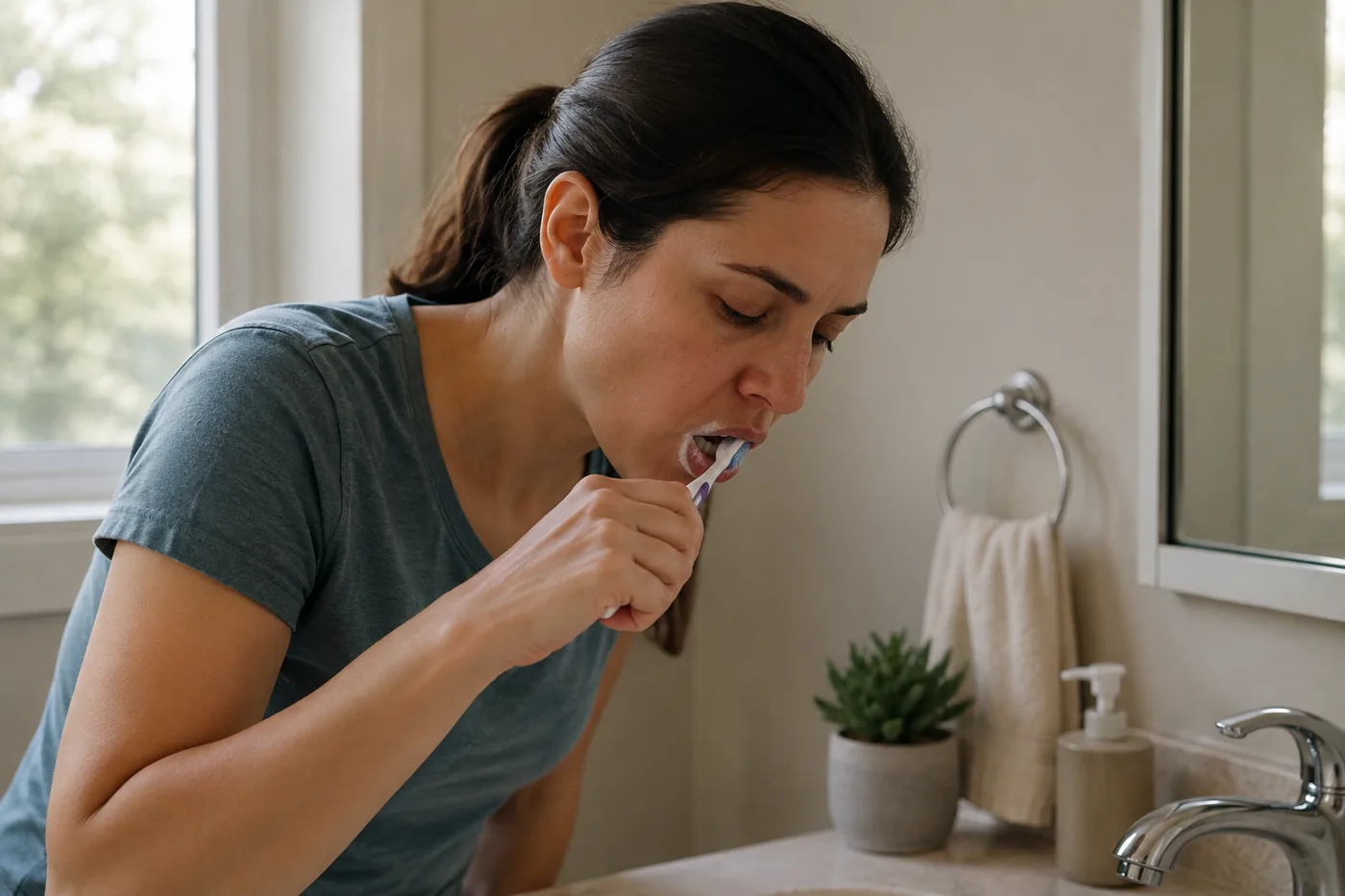
Yes, there's real dental logic behind this one. Stomach acid has a low pH. On contact, it briefly softens the outer layer of your enamel. Brushing right after vomiting or a reflux episode can scrub away enamel that's already in a weakened state, before saliva has a chance to buffer it back to normal. That doesn't mean brushing is off the table. It means timing changes the outcome. Rinse with plain water first, then wait roughly thirty minutes before you brush. The exception is when acid exposure happens often enough to already show visible wear, and that's something only an in-person exam can confirm.
What Stomach Acid Actually Does to Enamel
Enamel is hard, but it isn't inert. It's a mineral structure that reacts to pH. Your mouth normally sits close to neutral. Stomach acid is far more acidic, often somewhere around pH 1 to 2. When it reaches your teeth during vomiting or a reflux episode, it pulls minerals out of the enamel surface. That surface becomes temporarily softer and more porous than usual.
Saliva is the fix your mouth already has built in. It's naturally buffered, and given time, it neutralizes the acid and starts re-mineralizing the enamel surface. That process isn't instant. It takes somewhere in the range of twenty to thirty minutes to meaningfully shift the balance back. Brush before that happens, and a toothbrush's mechanical friction can wear away enamel that hasn't finished hardening again.
Why Brushing Right Away Feels Like the Safe Move
Most patients assume brushing immediately is always the protective choice. It makes intuitive sense. Something acidic just touched your teeth, so getting it off quickly feels like damage control. That instinct is usually right for food and drink residue. It's backward for stomach acid specifically, because the acid has already changed the enamel's surface chemistry by the time you reach for the toothbrush.
The honest version is less satisfying than a simple rule. Immediate brushing doesn't remove the acid faster in any way that matters. It adds mechanical wear on top of chemical softening, during the exact window when enamel is least able to handle it. A short wait isn't neglect. It's the more protective choice, even though it feels counterintuitive in the moment.
What I Look for After Repeated Acid Exposure
When a patient mentions frequent reflux, morning sickness, or a pattern of vomiting, I'm not just asking about brushing habits. I'm looking at the enamel itself for signs of acid erosion: a smoother, slightly glassy look to the tooth surface, thinning at the edges of the front teeth, cupped indentations on chewing surfaces, and increased sensitivity to cold or sweet foods. Isolated wear on the tongue-side surfaces of the upper front teeth is a particular pattern I associate with recurring acid exposure from the stomach rather than from diet alone.
None of that shows up from one bad night. It builds over repeated exposures. That's why the conversation about timing matters more for someone dealing with ongoing reflux or an eating disorder than for a single isolated episode of stomach flu.
What to Do in the First Half Hour
- Rinse your mouth with plain water right away to dilute the acid
- Swish a small amount of baking soda dissolved in water if you have it on hand, to help neutralize the acid faster
- Chew a piece of sugar-free gum to encourage extra saliva flow
- Wait roughly thirty minutes before picking up your toothbrush
Use a soft-bristle brush and light pressure when you do brush
When This Becomes More Than a Timing Question
One rough night after food poisoning isn't something to worry about long term. A pattern is different. If vomiting or reflux is happening several times a week, whether from a medical condition, pregnancy, or an eating disorder, the enamel exposure adds up regardless of how carefully you time your brushing. That pattern deserves attention from both a physician and a dentist, not just a toothbrushing adjustment.
Watch for teeth that look increasingly translucent at the edges, new or worsening sensitivity to cold, or a change in how your bite feels. Those are signs the erosion has moved past what rinsing and waiting alone can offset.
If Enamel Wear Has Already Started
For mild erosion, a fluoride varnish or a prescription-strength fluoride toothpaste can help strengthen what remains and reduce sensitivity. For more noticeable wear, especially on the biting edges of the front teeth, bonding or a thin restorative layer can rebuild the shape and protect the underlying dentin. Severe, longstanding cases sometimes need crowns to restore both function and appearance.
None of that replaces addressing the underlying cause. If reflux or recurring vomiting is driving the exposure, treating that source matters as much as any dental repair.
Questions I Hear About Timing and Technique
Does this apply to acid reflux even without full vomiting? Yes. Reflux brings stomach acid into contact with your teeth the same way vomiting does, just usually in smaller amounts. The same thirty-minute guidance applies.
Is mouthwash a good substitute for water? Plain water is enough for the immediate rinse. A fluoride rinse can be a helpful addition afterward, but skip anything strongly acidic or alcohol-heavy right after an acid exposure.
What if I don't have baking soda available? Water alone still helps. Baking soda speeds up neutralizing the acid, but it isn't required for the timing advice to matter.
Does this rule apply after every meal, not just vomiting? The same softening effect happens after acidic foods and drinks, like citrus or soda. Waiting a bit before brushing is a reasonable habit there too.
Can I still floss right away? Flossing doesn't involve the same abrasive contact with the enamel surface, so it's fine to do sooner if you'd like.
What to Remember Next Time This Happens
Rinse first. Wait about thirty minutes. Then brush gently with a soft brush. That order gives your enamel the time it needs to recover from acid exposure instead of adding mechanical wear on top of it. If vomiting or reflux keeps happening, the timing habit still helps, but it's worth talking to your dentist about the pattern itself, not just how you're brushing afterward.
Related reading
A few related questions come up alongside this one: whether Invisalign can correct bite alignment and how much natural tooth veneers actually require removing. Also worth reading: how chronic dry mouth affects teeth and teeth staying yellow after a whitening treatment. For the broader topic list, see the full dental topics index.
Mechanical friction meets enamel that's already acid-softened. Over repeated episodes, this can thin the enamel surface and increase long-term sensitivity.
Saliva has time to buffer the acid and begin re-mineralizing the surface. Brushing afterward removes plaque without extra wear on softened enamel.
A gentle rinse now and a soft brush later protects more than an immediate scrub does.